
Travel nursing is a great way to take your career on the road and see some amazing parts of the country. Whether you’re about to sign on for your very first contract or you’re already a seasoned traveler looking for the next adventure, having some solid travel nurse tips in your back pocket can be the difference between loving the ride and just getting by. This guide covers everything from getting licensed to sorting out your housing to making friends on the unit – and then some.

Fast Forward to Success: Quick-Start Tips for First-Time Travel Nurses
So you’ve just signed (or are about to sign) your very first travel nursing contract – now what? This section’s for you if you’re wondering what to do first. Start prepping about 6 weeks out from your start date – and plan to get to your new location at least 3 days early.
Immediate things to sort out for first time travelers:
- Double-check your nursing licenses across all the states you might end up working in – you don’t want any unexpected surprises!
- Make sure you’ve got all the details of your contract sorted – overtime pay, stipends for things like housing and meals, and what happens if you need to bail on the deal last-minute
- Get temporary housing lined up – a hotel or extended-stay for the first couple of weeks should do the trick
- Work out a basic budget covering living expenses for the next 8 weeks or so – you’re looking at $4 to $8 thousand in most places
- Get to know the commute to your new facility – try to stay within a 15–20 minute commute to your facility
- Get all your vaccination records, certifications, and qualifications sorted and stored in one easy to find place
- Get in touch with your recruiter to make sure you’ve got the lowdown on orientation
Later sections go into more detail on things like budgeting, packing, and working with recruiters – but for now, this is your quick-start guide to getting started.
Know Why You’re Doing This and Set Some Realistic Travel Goals
Before you head off on that first assignment you need to know why you’re doing it. Are you chasing a higher paycheck? Looking for the adventure of a lifetime in some new city? Or maybe you’re looking to build some much-needed therapy skills after a tough stretch? Whatever it is, get clear on it.
For most of us in travel nursing, the main goals are around paying off student loans – $20 to $40 thousand’s a pretty common target – or saving up for a down payment on a house. Some people are on a mission to tick off the top destinations – Seattle for the great outdoors, Austin for the music scene, or Boston for some of the best healthcare in the world.
Write Down 3 Real Goals for the Next 12 Months:
- How many assignments do you want to nail
- What’s your target savings (say $50 thousand)
- Which states or regions do you want to explore
How these goals will shape your choices:
- If you’re in it for the cash, look for rural assignments with higher stipends
- If adventure’s your thing, go for block scheduling to give yourself some real downtime
- If you’re looking to build your skills, target some of the top trauma centers or specialty units
Every now and then (we’re talking every 6 months or so) take some time to reassess your goals and make sure you’re still on track to get where you want to be.
Licenses Credentials and Compliance Preparation is Key
Most assignments last 13 weeks, and the last thing you want is to have to spend your first week or two getting your paperwork in order. Fast, efficient compliance’s going to be crucial to your success as a travel nurse.
As of 2025 the Nurse Licensure Compact has got 40 states on board – that includes places like Texas and Florida that are super popular with travelers. However, major states like California and New York are holding out – which means you’ll need to get a separate endorsement to work there.
Core items to get sorted and stored in a secure place in the cloud:
- Copies of your active nursing license
- Your BLS, ACLS & PALS certifications & expiry dates
- Immunization records & TB test results
- Fit tests and physical exams
- Skills checklists & recent performance evaluations
Get all the facility compliance forms done and dusted – that’s drug screens, background checks, online courses – within 24 to 48 hours of getting them – and keep a record of expiry dates & upcoming renewals (think “BLS up for renewal on 10/2026”).
Money Matters: Budgeting, Pay Packages and Tax Basics
As a travel nurse you can earn way more than you would as a staff nurse – but it’s only going to be that way if you handle your money wisely. You’ll need to manage those gaps in pay, your housing, and your taxes.
Here’s what makes up a typical travel pay package:
- Base hourly rate: $50 to $80+ depending on specialty and location
- Overtime pay: 1.5x or double time
- Housing stipend: $800 to $1,800+ per week depending on the city
- Meals and incidentals stipend: $300 to $600 per week
- Completion or sign-on bonus: $2,000 to $10,000
Get an emergency fund together, covering 4 to 8 weeks of living expenses before your first assignment – that’s $4 to $8 thousand in most places. Open two bank accounts – one for your pay & savings, one for everything else – so you can keep track of your travel-related expenses cleanly.
And then there’s the tax thing. You need to get on top of the “tax home” concept – that determines whether that stipend is going to be taxable or not. Get some advice from a tax pro who knows their stuff – it’ll be worth it. The right agency & recruiter can make a huge difference – you’ll want a team that’s there for support, good pay, and handling the inevitable hiccups you’ll run into at a new facility.
Do your homework by talking to multiple agencies before committing. Weigh up pay transparency, benefits, how much clinical support they offer, and how responsive they are to your needs.
Make a non-negotiables list before you start:
- Minimum weekly pay – don’t even think about it if it’s under $2,500 take-home
- Preferred regions – east coast, west coast etc – lets make sure we’re on the same page
- Your ideal shift schedule – are you a night owl or a weekend warrior?
- Floating policies and time off – what are you expecting?
When you’re vetting recruiters:
- What’s your typical response time? – do they keep you in the loop?
- How often do they check in with you during assignments? – do you feel supported?
- Have they worked with lots of first time travel nurses this year? – someone who knows the ropes can be a lifesaver
- How do they handle issues at a facility? -you want support when issues come up at a facility
Get everything sorted out before you sign that contract: weekend and holiday requirements, call expectations, and cancellation clauses. New travelers do best starting in a specialty they already know well rather than trying to pinch-hit while figuring out the travel nursing lifestyle.
Housing and Where to Live During Your Contract
Housing is often the biggest headache for travel nurses, especially in places like San Francisco, New York or Honolulu – they can be brutal on the wallet.
Don’t commit to a long lease straight away – use a hotel or apartment for the first week or two while you get a feel for the job and the area. One experienced nurse always stays in a hotel initially and scouts rentals to avoid getting locked into a bad deal too early.
Use your housing stipend wisely – choosing more modest housing can leave you with some extra cash as take-home pay while still keeping some comforts and a reasonable commute time. Try to live within 15-20 minutes of the hospital when possible – night shifters and winter weather states will appreciate that.
Lease fine print to review before signing:
- What are the cancellation policies & subletting rules?
- Are there pet fees, deposits, & breed restrictions?
- What about parking costs and included utilities?
For travel nurses with pets, keep those vaccination records up to date, research pet-friendly housing, and find some great parks or walking spots in the area before you commit.
Packing and What to Bring (and Leave Behind)
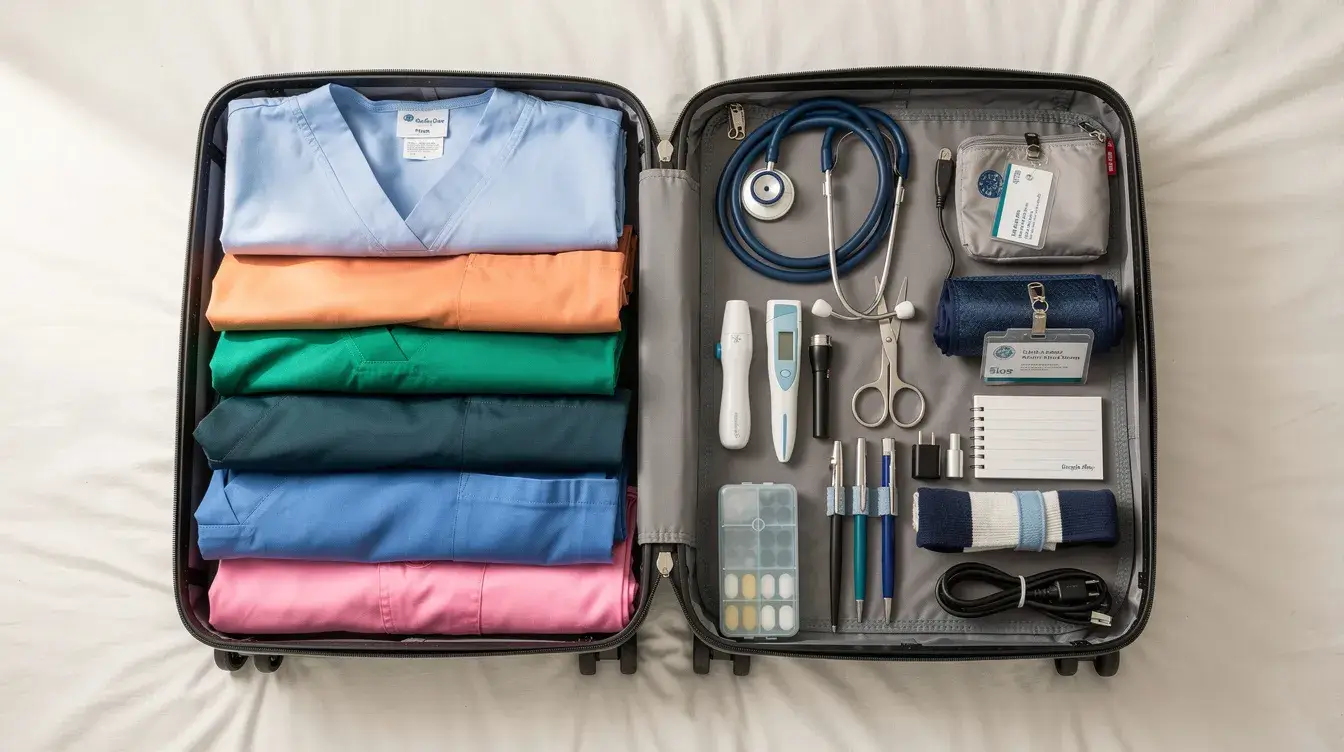
Packing is one area where it’s easy to overdo it – remember, you’ll be moving every 13 weeks and loading/unloading your stuff can be a real pain.
Work gear:
- 5-7 sets of scrubs – just in case
- 1-2 good pairs of comfortable shoes – those will get a workout
- Copies of your license and passport – better safe than sorry
- Pens, a locker lock, phone chargers – the essentials
Kitchen stuff:
- Compact pots & pans – space saver
- 2-4 plates and basic utensils – don’t forget the saucepans
- A good knife and cutting board – those are essentials
Clothing & personal stuff:
- One week of casual clothes that mix and match – you’ll want to be able to layer
- Buy toiletries locally to save space – traveling light is key
- Consider a streaming laptop over a TV – space saver
Leave those big furniture pieces and sentimental items in storage for at least your first assignment. Make a list of your packing essentials and take photos of things you pack to keep for insurance purposes.
Before Day One: Getting Your Bearings at a New Facility
You want to look like a pro on your first day, not some newbie who’s totally lost – even if it is your first time.
Arrive 2-4 days early to scope out the hospital, check parking or public transportation, and get a handle on the correct entrance and unit.
Get the lowdown from your recruiter and the facility:
- What time does orientation start and where is it?
- What’s the dress code or scrub policy?
- Where do you report & what’s the supervisor’s contact info?
Organize your documents for day one: contract copy, photo ID, current licenses and any facility-specific paperwork. If you don’t get a unit tour, ask for one – locate the medication room, supply room, crash cart, break room and emergency exits.
Get a handle on the charting system ASAP – jot down some quick reference notes for common flowsheets and order sets specific to your new unit.
Thriving on the Unit: Professionalism, Flexibility & Safety
First impressions in those first 3-5 shifts set the tone for the rest of the contract – be open-minded and positive.
Be friendly and low-drama: greet coworkers by name, offer a hand when you can, and try not to engage in gossip about the facility or other agencies. Flexibility is key – go with the flow, adapt to local workflows, and understand that “this is how we do it here”
However, don’t sacrifice safety for flexibility – if there’s a real safety issue, speak up and get it sorted with charge nurses and your recruiter.
Key things to keep in mind:
- Clarify unfamiliar orders and check with the facility on their policies
- Speak up during emergencies if something doesn’t feel right
- Identify a couple of go-to coworkers for quick questions in the first week
- Pay close attention to scheduling and timecard processes
Know your job description, understand who approves overtime, and get familiar with how to submit time to the agency to avoid any paycheck errors.
Building Your Support Network On and Off the Job
Travel nursing means leaving home and starting over every few months – you don’t have to do it alone. Join online communities specifically for travel nurses – Facebook groups and forums are a great resource for getting the inside scoop on local tips, finding housing leads, and just having a place to vent. Get connected in the local community by joining a gym, hitting up some community events, browsing the farmers market, or using apps to find new hobbies and meetups.
Stay in touch with your family and friends back home by catching up with video calls and group chats. Schedule visits to see them during your days off or between contracts.
Your recruiter is part of your support network too – make sure to keep them in the loop about how your assignment is going, especially during that first 2-3 week transition period when you’re still getting used to your new digs.
Documenting Your Experience and Managing Your Career
Travel nursing is not just a career move, it’s also a personal adventure that’s worth remembering.
Keep a simple record for each assignment:
- What hospital you’re at and which unit you’re working on
- Your start and end dates
- The names of your manager and charge nurse
- What skills you’re using and what you’ve learned
Make sure to get written or electronic references from your managers before the final week of each contract, when they still remember your awesomeness. Document your personal experiences too – take some pics, jot down some journal entries, or make a few videos to capture the memories of each place you visit.
Start looking for your next gig 4-6 weeks before your current contract ends, so you don’t have to deal with gaps in between. After every 13 week stretch, take a few minutes to debrief – what worked, what didn’t, and which agencies or facilities you want to go back to (or avoid).
Common First-Time Mistakes to Avoid
You learn so much from other people’s mistakes – it saves you money, stress, and time in the long run.
Pitfalls to watch out for:
- Signing a 6-12 month lease on an apartment before you even start working
- Underestimating how long it’ll take to get to work in a big city
- Not reading the fine print on your contract – things like cancellation clauses can be a real gotcha
- Not having a financial safety net to fall back on
- Overcommitting yourself and burning out halfway through a contract
- Assuming every hospital is just like your last one – trust me, that’s never the case
Don’t assume that every hospital has the same policies on everything from medication to blood products to restraints – each one is different. Ask questions early and often, especially in that first week, so you don’t get caught off guard later on.
Enjoying the Journey: Work-Life Balance as a Travel Nurse
You didn’t become a travel nurse just for the money – you did it for the adventure, the growth, and the variety. Don’t forget to explore each new city you visit.
Get the most out of each location:
- Plan 1 or 2 fun activities per month – go for a hike, check out a museum, try some local food
- Explore all the local landmarks – Pike Place Market in Seattle or the River Walk in San Antonio
- Check out all the local restaurants and attend some community events
- Find some regular routines to keep you grounded – like regular exercise, a good night’s sleep, and some portable hobbies
Not every assignment will be perfect, but each one is a new experience and a chance to figure out what you want next. Think of your travel nursing career as a series of seasons – some focused on saving money, some on adventure, some on rest. And in a short time, you’ll have seen more of the country than most people do in a lifetime.
Your travel nursing journey is an amazing adventure – personal and professional. Take the first step today, update your credentials, set your goals, and get ready for the world of possibilities waiting for you at your next assignment. The fun is just getting started.
Frequently Asked Questions About Travel Nurse Tips
What are the top travel nurse tips for beginners?
The most important things to know include understanding your contract, finding housing before you get there, getting your credentials in order, and keeping the lines of communication open with your recruiter.
How do travel nurses find good assignments?
Most travel nurses work with multiple agencies, compare contracts, and look at things like location, pay, and facility reputation before accepting an assignment.
How much can travel nurses earn per week?
Travel nurse pay can vary by location and specialty, but many nurses are making between $2,200 and $3,500 per week, including bonuses and stipends.
What mistakes should first-time travel nurses avoid?
Common mistakes include signing a long-term housing lease too early, ignoring contract details, underestimating living costs, and not preparing financially for gaps between assignments.
Is travel nursing worth it for new nurses?
Travel nursing can be a real game-changer – offering higher pay, flexibility, and new experiences – but it does require adaptability, strong clinical skills, and good planning.


